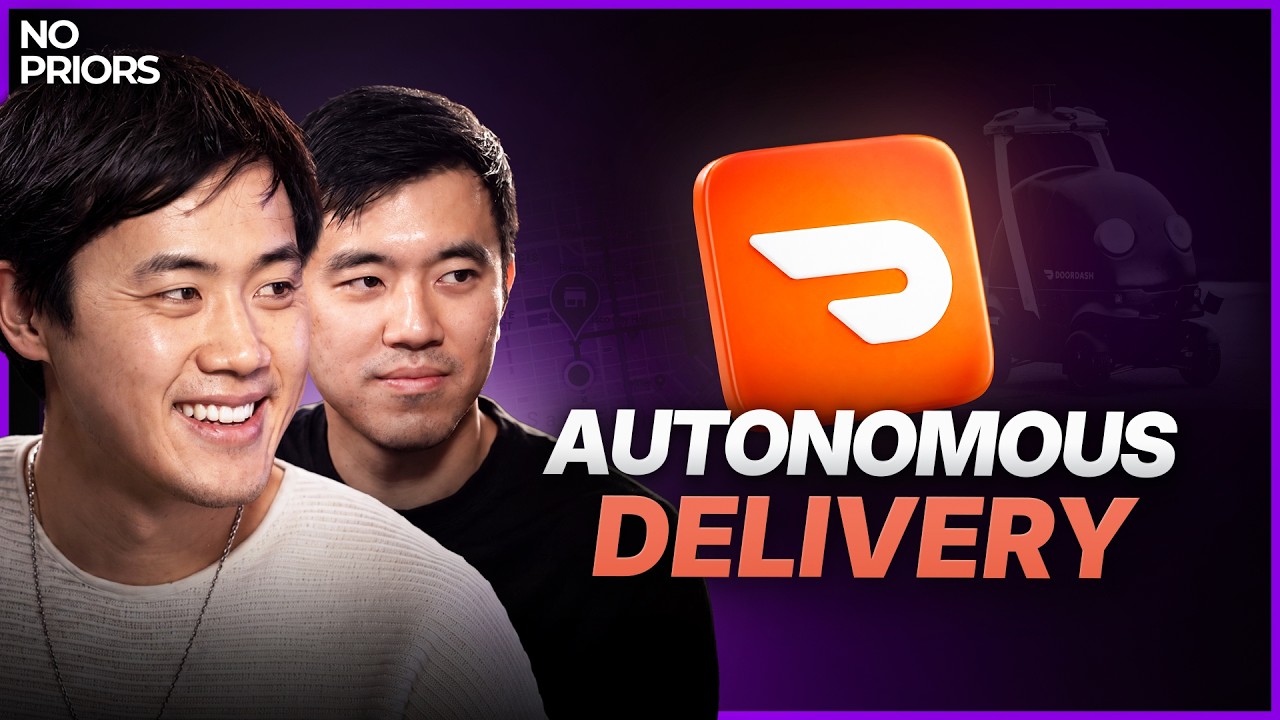
DoorDash 공동창업자 Andy Fang과 Stanley Tang이 No Priors 팟캐스트에 출연하여 **에이전틱 커머스(Agentic Commerce)**와 자율주행 배달 로봇 DOT를 중심으로 DoorDash의 다음 10년을 설명한다. 이들은 AI가 단순한 UI 개선을 넘어 소비자의 주문 방식, 물류 네트워크, 그리고 회사 내부 생산성 전반을 재설계하고 있음을 강조한다. 핵심 메시지는 **"기술이 먼저가 아니라 사용 사례(use case)를 먼저 이해하고, 거기에 맞는 기술을 역으로 설계한다"**는 것이다. 100억 건의 배달 데이터와 900만 명의 Dasher 네트워크를 보유한 DoorDash는 이 데이터와 운영 노하우를 바탕으로 음식·식료품·소매까지 확장되는 멀티모달 배달 생태계를 구축 중이다. 10년 후에는 오히려 더 많은 인간 Dasher가 필요할 것이며, 인간과 DOT, 드론, 보도 로봇이 공존하는 세상이 도래할 것이라고 전망한다.
2. 계층별 심층 분석 (4-Layer Deep Dive)
2.1 Agentic Commerce: Ask DoorDash의 탄생과 사용자 행동 변화
2.1.1 질문의 시작: 왜 자연어인가
- Andy Fang에 따르면, DoorDash의 에이전틱 커머스는 수년 전부터 음성(voice) 모달리티에 대한 실험으로 시작했다. 그러나 음성은 당시에는 사용자에게 잘 맞지 않았고, 대신 **자연스러운 대화형 경험(natural conversational experience)**에 대한 가능성이 두드러졌다.
- 사용자들은 기존의 키워드 검색이나 메뉴 탐색 대신, 머릿속에 떠오르는 것을 그대로 말로 전달하는 것을 더 쉽게 느꼈다.
- 예시: "주말에 가족과 파스타 저녁을 하고 싶어", "냉장고를 채워줘", "평소 주문하던 것들 다시 주문해줘" 등.
2.1.2 행동 데이터로 검증된 성과
- 레스토랑 발견 지표: Ask DoorDash를 사용하는 레스토랑 주문의 50%가 이전에 주문한 적 없는 새로운 가게에서 발생했다. 이는 DoorDash 역사상 가장 움직이기 어려운 지표 중 하나였다.
- 식료품 장바구니 규모: 식료품 주문에서 장바구니 크기가 평균 40% 증가했다. 사용자들은 식단 계획, 식이 제한, 재고 보충 등 복합적 목표를 자연어로 제시한다.
- 사회적 통화(social currency): 친구가 추천한 맛집을 쉽게 발견하고 공유하는 행동이 자연스럽게 연결된다. DoorDash는 단순한 주문 도구를 넘어 식사 결정을 돕는 동반자로 진화하고 있다.
2.1.3 세계 지식의 통합
- LLM의 지식 차단일(knowledge cutoff) 문제를 보완하기 위해, DoorDash는 외부 트렌드와 포럼 정보를 경험에 통합하는 투자를 했다.
- 인터넷에서 유행하는 음식, 지역 커뮤니티의 이야기, 최신 트렌드를 반영하여 사용자가 신뢰할 수 있는 추천을 제공한다.
2.1.4 미래 전망: 에이전틱 우선의 DoorDash
- 창업자들은 "오늘 DoorDash를 처음부터 만든다면 아마도 에이전틱 우선(agentic-first) 형태가 될 것"이라고 말한다.
- 향후 단계별 진화: 최근 몇 달은 사용자가 경험을 발견하고 실험하도록 돕는 것, 그 이후는 더욱 추측적이지만 에이전트가 사용자를 대신해 주문, 재고 관리, 사무실 식사 조율까지 처리하는 세상을 상상한다.
- Stanley Tang이 제시한 사무실 팬트리 사례: 카메라가 선반을 감지하다 재고가 줄어들면, 에이전트가 자동으로 DoorDash에 보충 주문을 보낸다. 이는 단순한 UI 혁신을 넘어선 물리적 세계와의 연결을 보여준다.
2.2 자율주행 배달: 8년의 로보틱스 여정과 DOT
2.2.1 2018년, 분명하지 않았던 시작
- DoorDash의 자율주행 노력은 2018년부터 시작됐다. 당시에는 아직 자율주행과 로보틱스가 대세가 될 것이라는 확신이 없었다.
- 창업자 주도 기업의 장점으로, 단기 실적보다는 미래의 변혁적 기술과 잠재적 교란 가능성에 대해 생각할 수 있었다.
- 처음에는 대규모 로보틱스 프로그램을 만드는 것이 아니라, Stanley Tang과 반명의 엔지니어가 참여하는 스컹크 웍스(skunk works) 프로젝트였다.
2.2.2 파트너십에서 자체 개발로
- DoorDash는 처음에 보도 로봇 업체부터 로보택시 업체까지 다양한 파트너와 협력하며 생태계를 탐색했다.
- 이 과정에서 세 가지 중요한 교훈을 얻었다:
- 자율주행은 가능성 문제가 아닌 시점 문제: 결국 실현될 것이라는 확신을 얻었다.
- 자율주행을 가능하게 하는 주변 인프라의 중요성: API, 디스패치, 상점 통합, 소비자 경험 등 단순히 로봇을 놓는 것만으로는 해결되지 않는다. 이를 위해 Autonomous Delivery Platform을 구축했다.
- 사용 사례 중심 설계의 필요성: 많은 스타트업이 기술을 먼저 만들고 문제를 찾으려 했지만, DoorDash는 실제 배달 문제에 맞춘 솔루션이 필요했다.
2.2.3 DOT의 설계 철학: DoorDash에 딱 맞는 형태
- DoorDash의 평균 배달 거리는 3~5마일, 실제 배달 시간은 음식 조리 시간을 제외하면 약 15분이다.
- 기존 보도 로봇은 시속 2~3마일로 너무 느렸고, 로보택시는 4,000파운드의 사람 운송 차량으로 배달에는 과도하고 비효율적이었다.
- 이 간극을 메우기 위해 DoorDash는 자율주행 오토바이/스쿠터 형태의 300파운드, 시속 20마일 로봇 DOT를 자체 개발했다.
- DOT은 보도, 자전거도로, 도로를 모두 주행할 수 있으며, 이는 현재 세계에서 유일한 배달 로봇 형태이다.
2.2.4 Phoenix에서의 실제 운영과 L4 달성
- DOT는 Phoenix(Tempe)에서 2년 넘게 실제 배달을 수행 중이며, 지난해 완전 자율주행 L4를 달성했다.
- 5년 전의 질문은 "자율주행이 가능한가?"였다면, 이제는 **"어떻게 확장할 것인가?"**로 바뀌었다.
- 확장의 3대 축: (1) 자율주행 스택 자체의 확장, (2) 운영 및 플릿 관리, (3) 하드웨어 제조 및 공급망.
2.2.5 멀티모달 전략: 인간과 기계의 공존
- DoorDash는 모든 문제를 하나의 모달리티로 해결하려 하지 않는다. 대신 사용 사례에 따라 최적의 수단을 선택한다:
- DOT: Phoenix 같은 밀집 교외의 3~5마일 배달.
- 드론: 도로 인프라가 열악한 농촌 지역의 가벼운 주문.
- 인간 Dasher: 복잡한 식료품 주문, 계단 오르내림, 픽킹·패킹이 필요한 케이스.
- Stanley Tang은 "10년 후 오히려 더 많은 Dasher가 있을 것"이라고 예상한다. 수요가 25% 연간 성장하며 폭증할 것이고, 자율 모달리티는 공급 부족을 메우고 비용 효율성을 높이는 보완재가 될 것이다.
2.3 데이터와 운영 우위: 복제 불가능한 경쟁 장벽
2.3.1 100억 건의 배달 데이터
- DoorDash는 10 billion(100억) 건의 배달 데이터를 보유하고 있다. 이 데이터는 다른 어떤 지도 서비스나 로보틱스 회사도 가질 수 없다.
- GPS 핀의 부정확성, 실제 상점 출입 위치, 고객 집 앞 도착 지점 등 첫 번째/마지막 100피트 문제를 해결하는 데 결정적이다.
2.3.2 30억 건의 연간 배달, 모두 다른 모양
- DoorDash는 연간 30억 건의 배달을 처리하며, 이들 중 어떤 두 건도 완전히 같지 않다.
- 지리(San Francisco vs. Dallas vs. Helsinki의 눈), 상품(피자 vs. 아이스크림 vs. 식료품), 상점 유형(McDonald's vs. 동네 가게)에 따라 모두 다른 물리적 조건이 발생한다.
- 이런 복잡성 때문에 단순한 데모가 아닌 **확장 가능한 서비스(scaled service)**를 만드는 것이 핵심 과제이다.
2.3.3 확장에서 드러나는 극단적 에지 케이스
- 실제 플릿을 운영하면서 마주친 예시들:
- 카메라 센서에 먼지나 흙이 덮이는 경우.
- 도로 가장자리의 낙엽 위로 바퀴 절반이 올라가 토크 불균형이 발생하는 경우.
- 급정거 시 재생 브레이킹이 배터리를 과충전시켜 전기적 충격이 발생하는 경우.
- 매일 아침 500대 로봇을 부팅하는 엔지니어의 임시 Jenkins 스크립트가 병목이 된 경우.
- 이런 문제들은 데모 환경에서는 절대 발견되지 않으며, 실제 운영의 규모와 시간에서만 드러난다.
2.3.4 인재 경쟁: 왜 DoorDash인가
- Stanley Tang의 인재 영입 피치는 단순하다: "프로토타입과 데모만 연구하는 박사 연구실에 갈 것인가, 아니면 실제 물리적 세계에 배포되고 사용자에게 영향을 미치는 것을 만들 것인가?"
- DoorDash Labs와 AI 팀은 순수 연구가 아닌 실제로 출시(ship)하는 것을 지향하는 문화를 강조한다.
2.4 내부 생산성 혁명: AI 네이티브 DoorDash
2.4.1 Metis 인수와 AI 네이티브 사고 주입
- DoorDash는 Metis를 인수하여 회사 전반에 AI 네이티브 사고를 주입하고자 했다.
- 대규모 기업의 직원들은 역사적으로 일해온 방식에 너무 익숙해져, 최전선에서 가능한 것을 상상하기 어려워한다. Metis의 인재들이 이러한 관점을 가져왔다.
2.4.2 DashBench: 코딩 ROI 측정의 시작
- DoorDash는 DashBench라는 내부 벤치마크를 공개하여, 다양한 모델과 도구가 코딩 작업에서 어떻게 수행되는지 측정했다.
- 목적은 AI 투자에 대한 ROI를 계산하고, 어떤 작업에 어떤 모델을 사용할지 최적화하는 것이다.
2.4.3 AI 지출의 폭발과 수렴
- 2026년 1월 대비 6월 AI 관련 지출이 20배 증가했다.
- 현재는 낭비 제거와 오픈 웨이트 모델 활용 등으로 지출이 평형 상태에 접어들고 있다.
- 코딩 작업이 가장 큰 지출 영역이지만, **비기술 조직(분석가, 계정 관리자 등)**에서의 성장 속도가 가장 빠르다.
2.4.4 현실 세계의 데이터 분포 문제
- 모델이 연구실 벤치마크에서는 잘 동작해도, DoorDash의 실제 엔터프라이즈 데이터에서는 성능이 떨어지는 경우가 많다.
- 데이터 스크러빙, RL 환경 구축 등을 통해 단순화된 문제에서는 성공하지만, 실제 복잡한 데이터에서는 여전히 한계가 있다.
- 이는 자율주행의 "고양이가 식기세척기에 들어가 있는 것"과 같은 물리적 세계의 예측 불가능성과 동일한 패턴이다.
2.5 전략적 통찰: 사용 사례 중심 vs. 기술 중심
2.5.1 YC의 가르침과 하드테크의 역설
- Y Combinator에서 배운 교훈: "고객을 위해 무언가를 만들어라. 사람들이 원하는 것을 만들어라."
- 그러나 하드테크와 로보틱스 분야에서는 종종 기술을 먼저 만들고 문제를 찾으려는 역설적인 접근이 나타난다.
- DoorDash는 소프트웨어의 고객 중심 철학을 물리적 세계 기술에도 적용한다.
2.5.2 기술이 아닌 문제의 복잡성
- Andy Fang은 DoorDash가 본질적으로 **물리적 세계 비즈니스(physical world business)**라고 강조한다.
- 기술 자체가 어려운 것이 아니라, 기술을 물리적 세계에 통합하고 확장하는 것이 어렵다.
- 이는 단순히 LLM이나 로봇을 "떨어뜨리는(plop)" 것만으로 해결되지 않는다는 의미이다.
2.5.3 파트너십과 Also
- DOT의 하드웨어 제조 확장을 위해 DoorDash는 Rivian에서 분사한 micromobility 회사 Also와 파트너십을 맺었다.
- RJ Scaringe가 설립하고 의장을 맡은 Also는 차량을 규모 있게 생산하는 노하우를 가지고 있다.
- 이 파트너십은 DoorDash가 모든 것을 독자적으로 만들려 하기보다, 강점을 보완하는 전략적 협력을 중시함을 보여준다.
3. 핵심 인용과 숫자 요약
| 구분 | 핵심 수치/사실 | 출처/의미 |
|---|---|---|
| Ask DoorDash 신규 가게 비율 | 50% | 레스토랑 주문 중 이전에 주문한 적 없는 가게 비율 |
| 식료품 장바구니 증가 | 40% | Ask DoorDash 사용 시 평균 장바구니 크기 증가 |
| DOT 무게/속도 | 300 lb / 시속 20 mph | 자율주행 오토바이/스쿠터 형태 |
| DOT 운영 지역 | Phoenix/Tempe | 2년 넘게 실제 배달, L4 달성 |
| 연간 배달 건수 | 30억 건 | DoorDash 전체 네트워크 |
| 누적 배달 데이터 | 100억 건 | 자율주행과 AI 트레이닝의 핵심 자산 |
| 월간 활성 소비자 | 4,000만 명 이상 | 사용자 행동 데이터의 원천 |
| Dasher 수 | 900만 명 | DoorDash의 인간 배달 네트워크 |
| 회사 연 성장률 | 25% | 향후 Dasher와 자율 모달리티 수요 증가의 배경 |
| AI 지출 증가 | 1월 대비 6월 20배 | 내부 AI 실험과 도구 도입의 폭발 |
| 로보틱스 시작 시점 | 2018년 | 자율주행이 대세가 되기 전 선제 투자 |
| DOT 개발 철학 | 3~5마일, 15분 배달 | DoorDash의 평균 운영 조건에 최적화 |
4. 전체 대본 (English Transcript)
Hi listeners, welcome back to No Priors. Today I'm here with Andy Fang and Stanley Ting, co-founders at Door Dash. We talk about how you can ask Door Dash in natural language for food and groceries. What that means for the future of Agentic Commerce, their delivery robot, DOT, how Door Dash has been a robotics company for the last 8 years, the data advantages of their network, and what all this means for 9 million Dashers and 3 billion deliveries a year. Welcome, Andy Stanley. Thank you so much for being here. Really excited to talk to you about um all the crazy stuff Door Dash is doing. I thought we could start with what's going on with uh Agentic Commerce at Door Dash. I feel like you have one of the largest rollouts of actually using AI to change what people consume.
Yeah. Um so what was the backstory here? I [sighs] mean it started a couple years ago honestly in terms of like our attempts to try to make a play here. It actually originally we were bullish on voice as the modality. um that >> and that ended up not being the thing. That ended up not being the thing, but maybe it's will in the future, but it just that didn't really land. But the thing that was very interesting for us was just this natural conversational experience. And I think, you know, what we've seen is just like people being able to like just like naturally just translate what's in their head into this interface versus trying to like do some research online and then or try to do some like keyword optimization stuff. like people just found it easier to search for things either more nuanced kind of restaurant discovery searches or different tasks on the grocery side. Um and yeah, we've just [clears throat] seen a lot of interesting traction that's uh upheld as we've expanded the roll out. What are you seeing in terms of behavior change from the user side? Like do I eat or buy differently? Yeah. So, I would say on the restaurant side, we are seeing people 50% of trajectories of people using Ask Door Dash for restaurants. Uh they're or 50% of those trajectories are people ordering from places they've never ordered from before, which is huge because that's one of the hardest metrics historically for Door Dash for us to uh move. And so, that's been big. And then another one is on the grocery side, we're seeing a lot higher basket sizes, like I would say like 40% larger basket sizes on grocery. And so people are like, you know, they'll take a picture of what's in their fridge and they'll say, "Help me stock up my fridge or they'll do meal planning with like maybe they have some dietary constraints or they'll like, hey, I want to like cook a pasta dinner this weekend with my family." Or even just like, "Hey, help me reorder uh like my you know, my usuals and like that's a lot easier than tapping through the the traditional experience." >> That's wild. I've never thought of Door Dash as difficult to use, but like that suggests there's like actually latent demand that wasn't being served because you it wasn't easy enough to like eat at new places. Correct. Yeah. And I think a lot of people on the restaurant side, it's like people build habits, >> but I think people also want some diversity in terms of like what they're eating, you know? Um, and so we felt like this experience ended up being a natural way to allow people to express that. Oh, think about the social currency of like my friend Andy found a new like really good restaurant for me. Andy's awesome, right? So, I feel like that's even a different way people look at Door Dash. And yeah, another thing that was an investment we made was actually like incorporating like world knowledge into the experience. So, what does that mean here? Things that are going on with restaurants outside of Door Dash. So like you know we'll see hey what's trending on the internet or what's stuff that's not in the models but stuff that people would find because like their knowledge cut off is too early but maybe it's like hey what's trending online or what are people talking about in various forums or whatever and kind of goes to your point of like hey like kind of want to eat what's cool and so like that was something we tried to incorporate uh into the experience to make uh people trust it more. How do you think uh people will buy or think about restaurants differently like five years from now? I don't know about five years from now. I realize it's really hard in the age of AI [laughter] like next step. So for Ask Nord Dash, I would say to start with maybe that's like the next couple months or so. I think it's making it easier for people to discover the experience and like figure out what to do cuz I think it can be intimidating if you just see like hey like there's like suggested queries that you can type but like some people don't know what to start with. So figuring out how to experiment and tinker with the user experience to kind of get people or encourage people to find use cases for it. I [snorts] think if I think further out then it's a little more speculative but you know Stanley and I talk about this all the time. It's like if someone were to create Door Dash today like I don't know like college kids in a garage trying to start Door Dash I think it would look very different probably more agentic first. You know, one stat that I always like to uh think about nowadays is just like there's more agent traffic on the web than human traffic, you know, and so it's like how do we have a Door Dash type experience that plays into that trend? Um, and so, you know, I think there's some interesting speculations there, but hard to say. What could my agent know about what I want to eat or what I want to um buy from a grocery perspective? like help me understand like how you think about richer context or how to be smarter there. Sure. I mean, one cool example is someone's like, "Hey, for our office, it's like I can just like have the like one of the cameras on the uh pantry shelf." >> It's like, "Hey, when the shelf starts to get empty, like I can fire off like a query to Door Dash to like stock up my shelf." >> Yes. This is a human being task here. Yes. Yeah. Yeah. And so that was kind of like I mean something we talk about more later, but like kind of our like early experimentation with our CLI is like that's kind of an example of like making it less friction for an agent to kind of like participate in that experience. Okay. Well, while we're here talking about user needs, yeah, >> I I've got to be like a top percentile Door Dash consumer. I don't know. I'm, you know, a lot of lot of customers at this point, but uh I host family dinner for like extended family every Sunday night >> and you know, we eat Door Dash because I'm going to cook for all these people every every week. [laughter] Uh or I can't all the time. Um and uh like I do the same thing every time, which is poll everyone, okay, who's coming? Oh, yeah. You know, and then these people have these allergies and whatever else and like does anybody feel like anything special? Yeah. And then you know I order and I'm like I feel like I feel like that's all the realm of possibility. You just put it on autopilot for me. I show up with my family's good. That is a use case that is I mean I think not exactly the same but like a similar use case is like the office lunch ordering kind of thing. It's like if you're the office manager it's like I don't want to like and then you got to like hey make sure you ordered lunch at this time otherwise it's not going to show up. And it's like again everyone has their own like allergies or dietary preferences and stuff. So >> Stanley, you guys are doing uh a whole bunch of things on the autonomy and robotics side as well. Like you your clearly your view of Door Dash as founders is broader and [clears throat] more ambitious than I don't know maybe just like the surface level view of it's a food delivery network or what whatever the first you know oneliner for the company was. Um how long ago did the robotics efforts start? Yeah, we've actually been looking into robotics autonomy probably much longer than people thought, like since 2018 actually. Uh, back when it wasn't obvious autonomy and robotics was going to be a thing. Uh, but we felt like this was going to be a technology that was going to be transformative to our space and potentially disruptive. And I think I think that's the nice thing about being a founder led company is like we are we get to think about kind of much more future speculative things that are on the horizon and and and constantly think about like how do we make sure we don't get disrupted >> by the next I think like like Andy said like the next Door Dash if it that comes along is not going to be someone that builds the exact same version of Door Dash but maybe with a better UI. It's going to be that would be dumb. Yeah. going to be like something like okay how do we incorporate AI agent to commerce how do we incorporate autonomy robotics drone deliveries uh etc and and I think I mean fast forward like seven eight years later I think you're seeing everything starting to play out in AI in robotics and autonomy seeing wayotes happening and I think you know we're glad that we we made that investment early on 2018 >> there's an amazing business in 2018 it was like less amazing than it is today I feel like that's a fair statement right um how do you think about like the timing and sequencing of these very long-term bets and like just it from a capital allocation perspective like when you can invest in these things. Yeah, I think it's it's probably the same of how we invest in a lot of things at at Door Dash is everything start out as experiments. I mean in a way that's that was the founding story behind Door Dash. Door Dash was a Stanford college like dorm room experiment. It started out as a website called politely.com with eight PDF menus and a Google voice phone number. And it was only once we figured out, okay, there's something here. Let's turn this into company. And and and that's basically we've kind of taken that philosophy throughout the past 13 years and and we've kind of applied it to autonomy as well, AI as well. I mean, when we first started in 2018, the intention wasn't, hey, let's go spin up this giant robotics program. Let's hire a roboticist, go build hardware. It was really we put together, it was me and half an engineer's time. It was a skunk works project. It [clears throat] was an experimentation to go, let's go explore like what's out there. Like we don't even know what autonomy looks like, how robotics is going to impact our space, but let's go explore. Let's go form partnerships. Let's go learn. Let's go experiment. Um and and and I think in the beginning the intention wasn't to build our own robot. Actually, we we didn't think we needed to build any of this technology. We thought, okay, we can just partner up with a bunch of folks like you know, back then we weren't you know, we didn't know anything about robotics. uh there's all these startups out there that have built robots and autonomy like why don't we just work with them we can essentially just be the platform uh we'll build the APIs we'll handle the distribution etc and we did that for about actually several years actually we worked with everyone in in in the space everyone from the sidewalk robot players all the way up to the the robo taxi players I'll say there's three things we learned through that experience I think one is it kind of validated or confirmed [clears throat] our belief belief that there's something here. Autonomy is a question of when it was going to happen, not if. And again, fast forward today, you're seeing you see the whimos driving, right? It's happening. So, we should keep investing. The second >> is I think it allowed us to learn what it takes to actually enable autonomy because it turns out there's a lot of things you have to build around autonomy, the infrastructure, the ecosystem. How does autonomy integrate with Door Dash? what deliveries you take on like um the operational aspect. It turns out a lot of things you have to build around autonomy in in order to make autonomy possible. It's not just you plop a robot in uh or like or even AI just plop a LM in and then things just magically happen. There's a lot of things around it and and and you kind of have to build a platform ecosystem. So one of the things that we ended up building is this thing called the autonomous delivery platform. Essentially, it's like what are all the products and technology, the APIs, the dispatch, you need to build now that in a in a post autonomy world where autonomy and robotics and drones are are every what are all the things you have to build? How do you integrate with merchants? What does the consumer experience look like? Uh and I think the last thing which I think is probably the most important thing we learned which eventually led us to realize we had to build this technology ourselves is really this idea of building towards a use case. Mhm. Yes. There's a lot of autonomy startups out there. Um but we it always felt like these these companies weren't really focused on a use case. It always felt like they kind of build the technology first. Mhm. And then retroactively try to go find a problem to fit into. Like these these things were all built in a vacuum. Which is kind of weird cuz cuz it's it's like cuz in in in software world like when went through YC like we're always taught to oh you got to serve the customer build something people want. That's kind of like drilled into you and then you can iterate. But then when it comes to like hardware and hard tech and AI and and robotics, it's see it's people just kind of do the opposite where they try to build the tech first and and and not really think about the use case they're building towards and whenever that happens, you just end up with something that just wasn't quite the right fit like like there's and and we went through this this this process where a lot of these companies out there, but it always felt like it wasn't exactly what Door Dash needed. Um like like for example you simple example is that you have these in in tonning world there's basically two buckets of category of of companies out there. You have these sidewalk robot companies which are kind of these two three m hour kind of water cooler on wheels super effective simple technology. Uh but we quickly realized the speed was like and distance was a huge limitation cuz you cuz the average delivery at Door Dash is about 3 to 5 miles. uh and and and the typical delivery times out 15 minutes. If you exclude the time it takes to make the food. So if you put a 2 m per hour sidewalk robot, it's just never going to work. And then on the other end of the spectrum, you have kind of the robo taxi players which really are designed for carrying people around. It's 4,000lb vehicle. It's go super fast. You're transporting people and but turns out the problem around carrying people and carrying goods is actually a little bit different. Like you don't need if you only have if you're only carrying a couple burritos around, do you really need a 4,000 4,000lb car with chairs and AC? Uh the pickup drop off problem is also very different in robo taxis. Um you know, you can walk to a Whimo. I mean, how how often have you taken a Whimo where it drops you off half a block or a block away from where you need to be, which is totally fine cuz you can you can walk, but packages can't do that. Like like how do you how do you solve that? what I call the first and last 100 feet problem. How does it does the food um get picked up at the merchant? What does that integration look like? And then on the customer, like how do you drop off the food? How do you find the driveway? You know, like people expect their food to be dropped off or or or the vehicle to be pulled up straight to the front of their driveway or their or their porch. Um so so so we when we kind of looked around and and asked ourselves okay like if you were to start first principle and again this has always been our philosophy at Door Dash like like if you were to start from the business the customer use case work your way backwards our first principles and you can build exactly um what we need to solve our use case what would that look like and we looked around turns out no one's really building that it's not a sidewalk robot it's not a robo taxi Um, we felt like the it was probably something in between that the right metaphor for us. Again, it's like if you're trying to solve that 3 to 5 mile delivery in dense suburb, which is where most of the deliveries happen, the right metaphor is probably a autonomous motorcycle or scooter or bike profile vehicle. And and you know, it doesn't need to be 4,000 lb. It's probably, you know, 300 lb. Uh, but also has to be a lot faster than sidewalk robot. let's go 20 25 mph. And when we looked around and saw no one's building that, we decided, well, if no one's going to do that, instead of waiting around and let's, you know, and wait for this happen, we're going to control our own destiny here. Let's invest in this and see what we can build. And and it took many iterations you know like we start looking at like went testing this with real door dash deliveries looking at our 10 billion delivery we've done extracting the insights we have on the operational learnings we have and that's eventually what led us to launch and ship which is kind of our in-house autonomous delivery robot. Um, so it's been a it's been quite a journey and but again this is something we look to bring to every aspect of the business whether it's autonomy, robotics, AI like it's it's always starts start out as experiments. It always starts out as what is the customer problem you're solving for? What's the use case you're solving for? Work your way backwards and then iterate and and validate kind of your hypothesis and slowly um build the product over time. That sounds extremely [clears throat] rational. I have a hypothesis and it's very cool. I want to ask you where we are in the life cycle of everybody getting these automated deliveries. Um I have a hypothesis and I'm curious if it resonates with either of you about like why uh and a lot of people in this era are are building technology first versus customer back. I think people think everything is going to work like ChachiBT. Mhm. Right. I [clears throat] just and like by the way like there was of course work done on uh instruction fine-tuning to get it to like be shaped in a product that was still a user experience but I I think the the mental model that people have like it's a general technology and it's just kind of like free to turn into different applications uh is what they're applying to lots of different things now and especially in autonomy my sense is people are like okay we'll make the model and then like the other stuff will be if not easy at least secondary. This is not my view at all. I Yeah, I agree with you there. I mean that's basically your methodology to building the dot form factor. I think maybe that approach works in like software land but like for at least for a business like ours like Door Dash is a physical world business. It's like you know you bring technology into physical world and the physical world is always a lot messier. It's a lot more complicated, a lot more nuanced. Uh, I I think one of the things I think people don't realize is just how complicated Door Dash is. I mean, we do what over 3 billion deliveries a year. There are no two deliveries that look the same. All three billion deliveries look look different. Uh, and they all come in all sorts of shapes and sizes and different geographies. like a delivery in downtown San Francisco is completely different than uh a delivery done in Dallas or or or even in Europe or in Helsinki where it's snowing or if you're doing a uh pizza is very different than ice cream like your your dinner is very different than your grocery order which is very different now that we're expanding to retail and and and pharmacy and parcels as well. It's like the diversity of deliveries that happen at Door Dash is so complex that I I think people sometimes don't realize just how nuanced the problem the problem the problem is. And and that's kind of how what we have to solve for at at Door Dash. And I think that's part of the been been the learning process especially when it comes to like building autonomy or even AI is how do you manage through all that complexity and again it always comes down to like like do you understand the use case and I think we just have such a huge advantage over everyone else because we have something that everyone else doesn't have is it's called Door Dash. We have 10 billion deliveries of data to extract from. We have uh all these consumers like you know over 40 million consumers ordering every single month like we understand the complexities of how to handle when things go wrong. How to integrate all across all different types of merchants. Like the way you work with a McDonald's or Starbucks is very different than working with a mom and pop sandwich shop. Like a a drive-thru restaurant is again is very different than a restaurant at a strip mall or downtown Main Street. and how do you handle kind of those different use cases, right? Different interaction, different pickup points. Um, I don't know if there's anything you want to add on the AI side. I mean, for me, like the kind of that analogy you brought up, I think I think about it in terms of the autonomy thing, but I also think about it in terms of like the hum like how the humanoid robotics space is starting to play out potentially where I mean we we also launched a product called Tasks a couple months ago where we're we're having uh people in the Dash fleet help basically collect uh data points to help train some of these world models. And I think we're so early there and I think there's so many different form factors that you can use and there's like different opinions on like what type of model is going to work versus not. Um, but I think unlike something like Chachi BBT, I think there's a lot of expense needed to invest in just like the V1 of this. I guess ChBT could cost a lot of money too. But I think there's a lot of pressure though to figure out how do I actually provide value like I have to be better than [snorts] what people can do today. Um, and you know whether it's DOT and like delivering something end to end or I mean you probably invest in like bunch of different players in the space but like there's real pressure to like be better than the alternative uh from either a quality and or a cost perspective. So yeah. Yes. Otherwise what are we doing? Yeah. Exactly. Um so for those of us who aren't in Phoenix like what is Door Dash dot and like tell us about the design of it? Yeah. So Door Dash Dot it's a autonomous delivery robot. It's built entirely in-house uh at Door Dash. It's uh weighs 300 lb, travels up to 20 mph. It's oneten the size of a car. It's the only deliver robot out there that's designed to travel not just on sidewalks, but also go on bike lanes on and and on the road as well. It's it's live in Phoenix. We've been live doing deliveries for uh almost two years now. Uh it's you know we do it's fully autonomous L4. So if you come up to Phoenix to Tempe it really feels like uh Whimo San Francisco. I'm going to state something and see if this is like a correct or you agree uh even beyond understanding the wealth of use cases. Like you need to know what the distribution of environments you're going to be playing in is in robotics. This is a huge problem for everybody where like it's not I think most people uh familiar with the area understand that it's not that hard to get a cherrypicked demo of like one cool success on a task, right? The problem is getting it to work on any object or in any environment. Um, and so there's this like, you know, huge question in the industry of like, okay, how are we going to go get data that feels like realistic data and like the best realistic data is the real world data actually. And so I think that's like a really interesting premise of like why you might have the right to go do this besides you want to do it for the quality of your business. Yeah. No, exactly. And I think that's again that's also where Door Dash gets to shine with our advantage is we don't necessarily have to solve for 100% of our use cases. I mean that's that's also part of our again that was part of the learning with our kind of the kind of the first early years when when we did the partnerships for how we built our autonomous delivery platform was understanding what kind of deliveries fits into what modality >> and and I think the vision was always was always let's not design something to solve for everything but instead kind of let's let's go with it with a how do you come up with a multimodal strategy where perhaps you know you have door dash Dot do kind of the the 3 to five mile suburban deliveries from a strip mall. Um so so right now we're live in in Phoenix. That's kind of our starting point with DOT. Uh that's kind of the perfect market for DOT, right? These dense suburbs yet things are still far far apart enough. Maybe if it's if it's a um rural area where there's poor road infrastructure, maybe you send a and it's a lightweight order, maybe you send a drone delivery for that. uh if it's a complicated multi-step grocery order where we have to climb go up and down stairs and pick and pack orders like you're still going to have a dasher for that. And I think that's the nice thing about Door Dash is you can kind of you don't have it's not an all or nothing approach. You can kind of phase in these modalities over time and [clears throat] pick and choose what the right again it's about the use case. what are the right use cases uh to to solve for what are the right modalities to to to fit into for for each of the each of the use cases like are there certain deliveries can carve out that makes a lot of sense robotics versus versus humans. Yeah. Um I also think that's really cool that you have control over the routing and the distribution where you're like I can I can accomplish this task. Exactly. And then and then from the consumer side and the merchant side it's like the exact same experience. still the same app for the customer that you can access everything. And then for the merchant, it's just one integration. Uh you already integrated Door Dash. All of a sudden, you you get not just Dashers, but you get drones, you get autonomy, you know, he had access to all the, you know, AI to uh tools and products every ship. And I think again it's it's like I think that's that is like that is like what ultimately like Door Dash is is building is like it's it's really like that ecosystem uh for local commerce and I think that is again that is like something that is really hard to replicate right and I think and I think it's again trying to trying to do that in the real world across you know you know like 40 50 plus countries and all these different jobs all these different merchants that's that's the hard part about about the business >> asking for a friend. Question of how you got here. Um >> there is an insufficient supply of researchers and people who you know know how to work on robotics or applied AI uh in the ecosystem for the recognition of all the different cool use cases you go after. Um and a lot of people gravitate toward like the general case >> like we can solve it once. Um uh I assume you're competing for some of those people. How do you convince people to work at Door Dash on these problems? Yeah, my pitch is really simple. It's it's it's basically like, do you want to go work on prototypes and demos and and do and be at a PhD lab or do you want to work on something where you can actually ship something in the real world? Uh, and I think that's kind of, you know, I think I think I think that's kind of really been the culture we kind of set up, you know, both at Door Dash Labs and all the AI efforts is is like this is we're not just here to do pure research. Like at the end of the day, like you we get to ship something where we have real impact. And I think people at least such an autonomy world for the past 10 years were just fed up just working on something for 10 years and you know never actually getting to a point where they actually saw their products being used in the real world. And and I think like for us like it's like because we like we've always been much more focused on creating kind of taking this much more pragmatic practical approach like we're not here necessarily to do like the it's it's not about oh let's go work on like a crazy moonshot idea. It's like let's get something out that can be shipped in the real world and actually start learning how these technologies um interact with the physical world and start iterating because again like technology these these things aren't built in in in a vacuum. You have to put something out in the real world make contact with the real world um and and actually learn learn from that. I think that's we've we we did that pretty early on for for Door Dash. Actually, again, I don't I don't think a lot of people know, we've actually been doing autonomous deliveries in Phoenix for over two years now. Like we we publicly announced last year or that we've been doing it for over 2 years, but really in the beginning it was just learning like, okay, like again, like I think you mentioned earlier, it's one thing to just do a fancy demo or have something that works in a one-off environment. It's entirely different to now. Okay, how do you turn this into a an actual scaled fleet, a scaled service, a scaled business? I mean the thing I always me talk about a lot is you know building autonomy uh business takes more than just autonomy. It's like how do you actually scale something in the real real world? Scale fleets. All of a sudden, you're running all into all these edge cases, right? Like you just don't see it. When you have to do something seven days a week, uh or 10 hours a day, 7 days a week at scale, things start breaking, right? Like it could be something as simple as I don't know like like a like a dirt covering one of your camera sensors. Okay. Like how does how robust is your autonomy stack able to able to handle that? like there's some there's some leaves on the ground. Uh but it only covers kind of cuz again our dot drives on the road but it would it tries to act like a bike. So it'll take the kind of the right side of the road or the the bike lane and if there's kind of leaves located along the kind of where the right where the sidewalks are. Maybe half your wheels the right two wheels are on the leaves the left two wheels are still on the asphalt. Yeah. Well, all of a sudden the the torque you have to send to the wheels is like very different and your autonomy stack and your and your kind of your um kind of your middleware and your and your kind of your your kind of low-level controls has to handle that differently like like that's something I would have never thought of if it was just like driving in a nice little demo environment. Uh it's like like things just start break like how do you handle operations? Like people don't think about actually in order to scale autonomy. There's a lot of non-aututonomy or like operations like you have to set up depots. Again, it's a physical world business. You have to set up depots maintenance like what if your battery like how do you recharge your battery? Like what if one of your braking system kind of uh like over uh you have you have to kind of like here here was an issue we ran into. It's like it's like there are certain situations where the the vehicle has to break so hard that it kind of the regen braking system overpowers kind of the the battery cuz it causes this electric shock, right? Again, like it only happens like extreme edge cases, but but there are certain situations where you have to do that because it's again something in the real world like like this thing had like safety is like some like is something that's super important. So if it can't handle that like you got to you got to you got to figure that out. Another example we we didn't think about is is as is booting up the robots like like when we're doing when this was still a demo project we like no one thought about oh boot up time right so so it's literally the the the original version of of of of the robot boot up was a kind of this simple Jenkins script that one of our engineers hacked together like like [snorts] in like a couple hours and then which wor which worked fine but then now you're doing like hundreds of robots a day every morning needs to get booted up and the script, you know, like crashes half the time. It takes like 30, 45 minutes, but to multiply across 500 robots, all of a sudden it's like, holy crap. It's like it's like there's this huge productivity becomes this huge productivity issue. [snorts] >> Um and and then and then of course it's like how do you think through like reliability uh you know now you have to start thinking about manufacturing supply chain and of course the kind of the operational aspect of of actually how does how does this thing interfate with merchants uh how do you handle how do you do the pickup drop off problem how do you educate the merchant uh like how do you even find the pen the the location of a customer's home uh which again sounds kind of silly but when you punch in someone's address on Google Maps like the GPS pin. It's like especially if you're going to apartment complex is never kind of I mean I mean it's not like always the exact same spot. Absolutely. But if you're a human it's like you kind of figure it out, right? Like you kind of don't think about it. It's like oh yeah a human dasher shows up. They they can kind of find where the restaurant is. This is the building. This is the front door. You can't do that with a robot. The robot's going to show up to a pin and all of a sudden it's like well okay which which where where's which which front which storefront is it? Which front door is it? Which gate is it? Now just imagine dot looking around. Exactly. Right. And again like that's something you have to figure out. But the nice thing is again Door Dash has that data like we >> all the drop off like we we can see where people are actually dropping off the package. Yeah. Where did the human dasher drop it off historically and that is you know like again it's that first and last 100 ft problem like you don't that that data doesn't exist anywhere else. It doesn't exist in Google Maps. It only exists at on at Door Dash. Yeah. I think that is a uh a really interesting and genuine advantage. Um early on when people were like talking about what's going to happen with [clears throat] AI and incumbents and startups, there were a lot of people I think had a very surface level view of like what the incumbent data advantage was. Yes. Um because they didn't like really think about like well what are we trying to do like what is the use case? What is the intelligence supposed to accomplish? And so they'd be like ah like we have the I don't know customer records and database and I was like that actually has like very little to do with the thing we're trying to we could try to accomplish with an agent right and I think this is totally like real in >> um in robotics where um I'm an investor in a company called Sunday right and um one thing that we like deeply believe in this company is you you can't imagine the distribution right as soon as you like make contact with the physical world as you said or the like the real world. You're like, "Man, if we're trying to do the dishes, why is a cat in the dishwasher?" [laughter] And like, you know, you're in somebody's real house and they're like, "The cat likes the dishwasher." They're like, "That's not, you know, that's not something you're going to go imagine." Just like you're not going to imagine like, "Oh, I'm going to deal with this torque problem where like one wheel is on the leaves and not >> and then you like think >> like, okay, but like how important is that in the distribution?" And then you find another cat in another dishwasher when you have enough data and you're like like I don't know how many of these are out there but like the only way to find out is not by an engineer sitting and being like let me imagine this the setup and the scenario for this robot. Like that's clearly not going to be the reality. I just feel like for the next frontier of AI it's, you know, at least what we're really excited about is like what how it's going to affect the physical world, you know. And I think to your point, it's like >> you can only simulate so much. you can only like you know uh you know pretend and imagine various demo situations. So [snorts] um I think one thing that we're very I think another thing that makes us very confident is like pairing that worldass operational expertise that we have with world class technology >> and I think you know a lot of AI researchers are very hesitant to do a lot of the operational stuff or they think it's like easy to handle but I think one thing that's really powerful about what we have here at Door Dash is we have a world-class operations team that you can partner with whether it's to collect or annotate data whether it's to figure out how to deploy robots and figure out how to like get the fleet operations to work. Um, and I think for a lot of people we talked to that's very compelling because it's like, hey, actually there's a we're not just talking hypothetical here. You know, >> you're making the deliveries in Phoenix. What are the challenges from here for scale up? I mean, we've been doing deliveries in Phoenix for over two years now. Uh, I mean, we went fully autonomous L4 last year. Uh, I mean it's it's like we I think that was a super exciting milestone and and really it's just a matter of like how do you take this from again it's like originally it was just couple robots 10 robots to 100 again it's just like we got to make that hill climb of like how do you how do you scale this whether and I think it's really three three components is can we get the autonomy to scale 5 years ago the question was like was autonomy even possible like was this was this just a research project is this a science fiction um you see kind of Now with especially with AI like Whimo's kind of made that breakthrough. I think Tesla's starting to make that breakthrough. We made that breakthrough last year. Um like our entire autonomy stack is built inhouse but purpose built for for delivery which is again it's it's a little bit different. You can't it's not just copy. I think this is the other thing people miss is you don't you can't just copy and paste what Whimo's done and then plop it into the door dash dot and everything works. It's it's again it's the use case is a little bit different. This is a bike lane profile vehicle, but is that's constantly navigating between the road and the sidewalks. Uh, as far as I know, this is like there's nothing else like this in the world. Uh, besides that even behaves like Door Dash dot. Uh, but we kind of built it because we kind of built it uniquely to our use case. So autonomy is definitely bit one piece like how do you keep scaling um across not just Phoenix but want to bring to Bay Area more cities you know that I'm sure we're going to run into more more and more edge cases. Um but the funny thing is like the autonomy is probably increasingly becoming less and less of a constraint of of a blocker. It's really like now how do you it's really more the next two which is um the second is like operational like how do you scale operations restaurants behave in in Phoenix look different than restaurants in in San Francisco versus like you know London versus Helsinki how do you adapt to all these different integrations how do you >> so it's the interface layer and then like the fleet management of it >> interface and fleet management and then the last piece is is is hardware like how and it's kind Funny. It's like when we first started like 5 years ago, like everyone thought hardware was a commodity and now it's starting to look like hardware is starting to become bottom. Like it's like we hand built the first 100 robots ourselves and which is not an issue. But then okay, the next thousand or 10,000. Well, we're going to have to now we're starting thinking out things like supply chain and like like component reliability like it's it's like it's like these things has to last for a really long time. Uh it's like how you think about um it's it's it's like it's it's >> and you're not guessing because you can actually tell how long it needs to last and how it's doing in the field. Exactly. Right. manufacturing like it's like it's like learning learning all that and that turns out to be pretty hard problem at scale and so so one of the things we we actually did was is is um uh we actually uh partnered up with this company called also which is this um micromobility company that's spun out of Rivian so um RJ is actually the board founder and and chair chairman of the company so [snorts] >> if you know like why don't we work with someone who's who knows how actually scale vehicles and and so so that's kind of one of the uh partnerships we we we struck up. But it's kind of funny. It's like the the problem 5 years ago was autonomy. Now it's increasingly becoming more about operations, commercialization, hardware, manufacturing. And again, it's like this is I feel like this is where Door Dash again gets to shine with our scale advantage and operation advantage is how do we take this thing from not just 0 to1 but like 100 one,000 >> 1 to three billion. Yeah. 1 to three billion. Right. And I feel like Door Dash is just so well positioned to to to take on this like it's it's like we have just such a unique advantage here and I think that's that's what that's where we want to play in terms of our play play to our strengths. So you have these enormous strengths. You've got the network and the existing great business and these like two, you know, amongst others, I'm sure, like two really big plays around agent commerce and around autonomy. How do you think about just it's it's a 10,000 plus person company and like a lot of that company is ops, a lot of that company is technology. Um, and I'm sure you're thinking deeply about productivity of that workforce, >> like [clears throat] who owns it, what matters today, you're publishing benchmarks, like talk about that. I feel like in the past couple years, what was required to really operate at high level in the technology industry has changed a lot. And I think [gasps] one of the reasons why we were so excited to acquire a company called Metis last year was really to just infuse some of that AI native thinking into the company. And I think for a company of our size, it's been really and I think every company is every large company at least is facing I think a lot of startups I mean you you see this better than anyone else probably is like the way they operate is so different and I think a lot of people at our company they they have struggled to to see what's possible because they're so used to how things have worked historically. And so I think really figuring out how do we bring in people who actually have seen what is possible on the frontier and [snorts] incorporating that into how we do our work. And I think you know coding is obviously like the most like obvious place to do transformation and we've seen a lot of gains there. Um but there's also work we're doing in terms of how do we do AI enablement across the entire organization. And so I think [snorts] you know figuring out how to like benchmark various parts of the company. I think we we announced a benchmark called Dashbench a couple weeks ago now that was mainly focused on our ability to figure out how well various models and harness performed on coding tasks. And so that was a really good initial exercise for us to figure out how do we calculate the ROI on all this money we're spending. I mean I think I was looking at it a week ago. I think our spend in June went up like 20x versus what the spend was in January. Uh >> Wow. Yeah. And so I think it's like okay like clearly this has got to get some sort of return and so um and obviously like I think we're seeing a lot of um [clears throat] you know >> can I ask you can you can uh not answer but like since you have inspected this spend like has it come down has it been flat has it continued to grow? Um we're seeing it flatline. Okay. Um, and I think a lot of it is through through some of these intentional efforts like cuz I think you know when people were experimenting with especially at the beginning of the year or like maybe like December last year it's like I think there's just like a step function change in terms of what was possible and so I think a lot of it was just experimenting and letting people run with it but it's gone to a point where it's like okay one there's like easy things we can do to like make sure that like we're not doing wasteful stuff but two is like you know as it relates to this benchmark that we released it's like okay we actually need to start calculating the ROI like you know if there's a way for us to get maximize the intelligence but maybe like delegate to open weight models for some of the cheaper tasks we can actually do we can get the fable level of intelligence but actually pay less than if we were just using these uh closed weight models so I think coding is kind of where we think there's a lot of opportunity mainly because I mean the vast majority of that spend is still within like engineering related tasks but we're actually seeing the highest amount of growth in our organization in terms of like seats in the non-technical organizations because you know analysts are finding a lot of value in it our operators you know um account managers who are trying to figure out okay how do I do my QBR with the strategic merchants how do we like automate a lot of that and so I think you know there's work we're doing there to figure out okay how do we benchmark some of the work we're doing in some of these other areas and I think the another thing that is interesting for us is cuz we work with some of these frontier your labs on like okay like for like accounting tasks or analytics tasks like how well do the latest models perform and I think a challenge that we've run into is like we'll ask our teams like hey how well do the models perform on your task they're like yeah it works okay and I think you know but then when we do >> and you're like okay like $30 million of okay >> yeah exactly it's like the the cost but then it's like okay when we then when we send somebody's data to the labs we'll have to do like the data scrubbing and then we'll have to like you know you know put in like RL environment whatever and then you know then the models crush it but then we're like there's clearly it's kind of like what you're saying with like the the Sunday robotics example it's like okay if you like dumb down the problem maybe the models do well but like for some reason and when we actually have it with the enterprise data with all the real stuff it's not performing as well and so I think for us it's a question of like hey is it because >> like there's just things that we need to do with the harness to get the model to perform or are there inherently things that the models just don't have uh in their data distribution or whatever capability set that is not allowing that step function change enablement in like accounting analytics or you know finance functions and so I think that's like kind of like the next step for us beyond the coding stuff which of course there's a lot of work for us to do but I think there's a lot of interesting things in terms of like how do we really see that step function change across the work >> is the long-term view like You get rid of all the dashers and it's just dots everywhere. What happens? Yeah. Well, my take, my prediction actually is in a world where robotics, drones, AI is is everywhere. Uh my guess is that in 10 years time, we're actually going to have more Dashers doing doing deliveries, not less. uh simply just because again I think it's just the well one I think the pace at which Door Dash is growing is just I mean and the scale at which we're operating is is pretty insane. I I don't know if people know, but like we have over 9 million dashers doing deliveries and the business is growing 25% year-over-year. Like fast forward 10 years time, like like and if we want to 5x from here, 10x from here, well, where are the where's the supply going to come from? Like are you going to have half America doing doing deliveries for us every month? Like that's probably not going to be the case. like like there has to be we're going to have to find other areas of opportunity to both bring in new modalities as well as improve efficiencies within our business. I think and I think dot robotics drones like Whimos like sidewalk robots I think we're going to you're going to see a world where we're going to have this multimodal fleet like we're going to need our hand get our hands on every single modality we can get. So, I think you're not only going to see more autonomy and more robotics, but I think you're going to see even more humans as well. And I mean I mean and and and I think I also just think like with the introduction of autonomy and robotics like and and efficiency gains you're going to see over time like I also think you're just going to see a even stronger surge in in demand as autonomy as delivery becomes um even more affordable and >> I look forward to getting these a day. [laughter] >> Uh amazing. And um Andy, when you think about what you've learned with the initial foray into agentic commerce, like how are people going to buy differently in the future beyond food? Yeah, I mean I think one of the trends that I found fascinating is like over the past couple years, Google search query links have gone longer. Um and I think to me how I've translated that is like okay, people feel more comfortable like talking to like agents or to like apps like they would a normal human being. And so I think if we fast forward and look ahead to the future, I think the easier we can make it for people to kind of interface with apps or with agents like they would with a person, I think it's going to reduce the friction in terms of their compelling them to place an order, whether that's for food or for like their groceries or for retail, what have you. And I think another thing that I think is going to be true is I think we're all going to need to think about like what does the agent first experience look like. Um and you know I think we've been testing some of that with the recent Door Dash CLI that we launched last week. Um but I just think there's a lot of interesting emerging use cases that can crop up um once once you start thinking about this. Like one concrete example I can talk about is like someone who was really excited to use the Door Dash CLI because they're like, "Hey, let me like basically streamline my office manager use case for my startup." And when they found out that Door Dash did more than just lunch, they're like, "Oh, actually wait, Door Dash can order me like convenience and groceries." So then they just pointed a camera at their pantry shelf. And whenever the shelf was getting empty, like they would fire off uh the agent to basically restock the shelf. So, I think those types of use cases that you wouldn't really think of, but I think it's going to unlock some interesting use cases that I think would not really be as feasible or possible like in today's world, but as we make things more naturally agent first, I think some of these use cases are going to become a lot more interesting. [snorts] >> Amazing. I love how uh ambitious you guys are for both the user experience and the uh scope and scale of Door Dash. Thanks, guys. Yeah, it's a pleasure to be here. Find us on Twitter at no prior pod. [music] Subscribe to our YouTube channel if you want to see our faces. Follow the show on Apple Podcasts, Spotify, or wherever you listen. That way, you get a new episode every week. And sign up for emails or find transcripts for every episode at no-briers.com.